Sofa Selection Tips for Comfortable Living
A sofa can look generous in a catalogue and still become a difficult piece of furniture in a Singapore home. The photograph may show a deep seat, soft cushions and slim legs, but it does not show your HDB flat’s corridor turns, the distance from the lift, or the number of people who must help carry it through the door. Because a sofa is part of bedroom design as much as it is a place to sit, its dimensions should be checked before its colour or decorative details.

Last month, I visited a client’s three-room flat in Tampines with a colleague from MIDHILL. We were reviewing a solid wood sofa, bed frame and dining table for the bedroom-design plan. The proposed sofa measured 238 cm wide, 98 cm deep and 82 cm high, with a packed weight of 78 kg. The lift door was 90 cm across, while the corridor narrowed to 112 cm at one turn. The sofa could pass the lift in theory, but its diagonal length made the turn risky. The client had not noticed that the lift opening would determine whether the piece could enter the home at all.
This guide explains what to check before buying a sofa you cannot sit on. “Cannot sit on” can mean that the sofa is too deep to use comfortably, too high for older legs, too soft to rise from, or physically unable to reach the living room. The final inspection should cover the seat itself, the route into the home and the long-term care of the upholstery and frame.
How deep and high should a sofa seat be for everyday use?
Start with the seat rather than the silhouette. A usable seat depth is generally 55–60 cm for an adult who wants to rest their feet on the floor. A depth of 64–70 cm can work for lounging, but it changes posture and occupies more floor area. Check the height of the compressed cushion, not only the listed frame height. A seat at 43 cm is easier to stand from, while 47–50 cm suits relaxed, higher seating. In a compact HDB living room, each extra 10 cm of depth can reduce the circulation space around the sofa.
Sit down before delivery and remain there for 10 minutes. Can you reach a remote control or cup without sliding forward? Can you stand without using both arms? Are the back cushions supportive rather than pushing your shoulders forward? Back height should provide support from the lower back to the shoulders, usually between 40 and 55 cm above the compressed seat.

Consider who will use the sofa. Children and older adults may prefer a firmer seat around 43–45 cm high. A 65 cm-deep model may swallow a smaller user. Conversely, a 40 cm-high sofa with shallow cushions may feel too upright for evening use. A firm edge also helps when someone needs to stand quickly. Test the sofa with the cushions in their delivered arrangement, because loose cushions can disguise an overfilled or poorly scaled frame.
Upholstery matters just as much as geometry. Request a sample and rub it with a clean cloth. performance fabric with a tight weave should resist everyday spills, while linen needs a protective treatment. Check that the seat covers can be removed for cleaning, and confirm the cleaning instructions in writing. A sofa intended for daily family use should not depend on specialist dry-cleaning for every small mark.
Will the sofa actually fit through the lift and corridor?
Measure the route from the building entrance to the intended room. Record the width and height of the lift door, the internal lift dimensions, the corridor width, any 90-degree or tighter turns, staircase widths, door widths and ceiling clearances. Give the seller the smallest measurement, not the broadest one. For a boxed sofa, ask for the package dimensions rather than estimating from the assembled frame.
In Singapore, common HDB access points can be tight, especially in older blocks. A sofa arm of 18–22 cm may be removable, but its screws and connectors must also fit. If the longest side is 220 cm, diagonal positioning may help, provided the lift’s internal depth allows it. A useful rule is to compare the package’s longest dimension with the lift door’s diagonal, while allowing 5–10 cm of working clearance. The corridor then needs enough turning space for the sofa’s length and depth.
Check whether the building requires booking a service lift or moving permit. Some management offices impose specific hours, protective floor covering or an approved mover list. A delivery fee quoted only for the doorstep is not the same as delivery into the living room. Ask who carries the sofa beyond the lift, whether stairs are included, and what happens if the piece does not fit.
One practical test is to mark the route with 50 cm-wide tape on the floor. Imagine carrying a 220 cm-long parcel through it and turning at each corner. This simple rehearsal often reveals an issue before a heavy sofa reaches the block. For homeowners in Bedok, Punggol and Tampines, send photographs and a dimension sketch to the supplier before ordering.
What should I check in the sofa’s frame, cushions and joints?
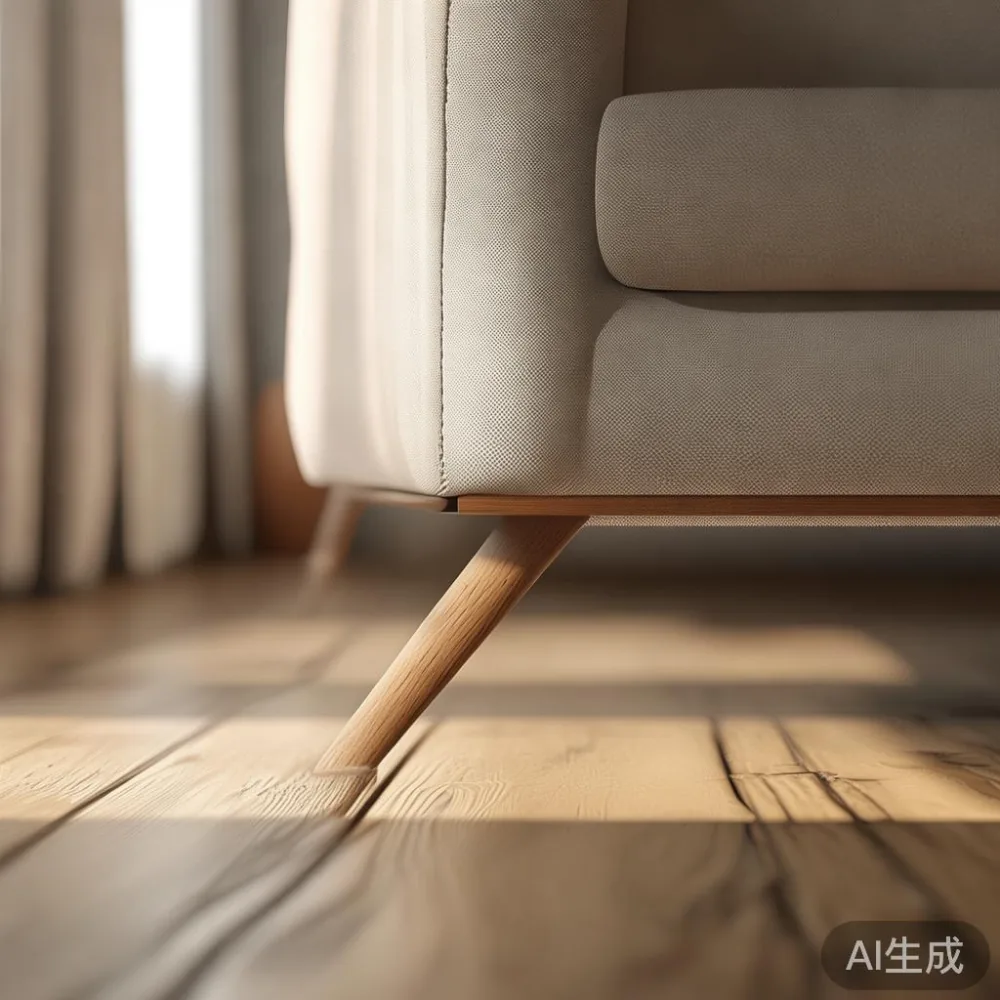
Look for a frame that can handle repeated sitting without wobbling. A solid wood sofa may use kiln-dried hardwood for the main structure, plywood or engineered timber in controlled panels, and corner braces that resist racking. The joints should be tight, the legs should be level and the frame should not twist when you press diagonally at the front corners.
Do not treat “solid wood” as a complete description. Ask which parts are solid wood, which are plywood, how the timber was dried, and whether the visible surfaces are veneered. In a post-modern light luxury treatment, ash, oak or walnut can be paired with rounded upholstery, but the construction details still determine how the sofa ages. The relevant questions are frame species, cushion density, spring or webbing system, joint type and warranty period.
Seat cushions should recover their shape after being pressed. A density figure around 35–42 kg/m³ can offer useful support, although the construction and foam quality also matter. The back cushions should be filled sufficiently to support the spine without appearing rigid. Under the seat, look for a dust cover, labelled care instructions and accessible fasteners. Screw-fixed legs are easier to replace than permanently glued fittings.
Sit near each arm and test the sofa with about 75 kg distributed across the seat. Listen for creaks, flexing or movement at the joints. Then push down gently at the front of the seat cushion. Excessive movement may indicate that the cushion is overfilled, while a sharp edge may reduce comfort. These checks take 5 minutes and can prevent years of irritation.
How do price, delivery terms and warranty affect the decision?
A quoted price in Singapore should be clear about GST. A solid wood sofa displayed at SGD 1,850 may become SGD 1,959.50 after 9% GST. Compare like-for-like specifications, including delivery into the room, assembly, removal of packaging and any stair charges. Under 2000 French provincial furniture can include substantial pieces, but the total must still be judged by frame quality, finish and fit rather than a rounded number alone.
MIDHILL is a Foshan solid wood furniture maker established in 2008, with a 10-year structural warranty and lifetime refinishing. It exports to more than 15 countries and offers free shipping for orders over US$350, along with a 14-day return policy. For a Singapore purchase, confirm the local currency price, GST treatment, delivery days and whether the structural warranty applies to the exact frame and finish being supplied. A lifetime refinishing service is different from a promise to replace every damaged component.
Ask for a written delivery window. A realistic appointment may be 7–14 days after stock confirmation, while made-to-order upholstery can take 30–60 days. For a condo, confirm loading bay access, parking restrictions and the service-lift booking. For an HDB flat, check the designated moving hours and whether the supplier carries the sofa from the lift to the door.
Leave 5–10 cm between the sofa and nearby furniture for cleaning and circulation. In a compact bedroom design, that clearance helps prevent the sofa from becoming a visual and physical obstacle. Record the sofa’s location on the delivery note, especially if the building has several similar corridors.
Can the sofa work with the bedroom design and the rest of the furniture?
The sofa should relate to the room’s proportions and the furniture already in place. In an open-plan HDB living area, a sofa of 190–220 cm may suit a dining area without blocking the television, while a 240–260 cm model may crowd a 3.2 m-wide living and dining zone. Measure the wall, skirting and any projecting air-conditioning ledge before selecting an oversized three-seater.
Style is more than matching wood tones. French light luxury often uses pale upholstery, curved profiles and restrained moulding. American light luxury may pair deep neutral fabric with clean lines. Post-modern light luxury can introduce a shaped frame, subtle asymmetry or a refined mix of timber and stone. The sofa should complement the solid wood bed frame, dining table, wardrobe, nightstand or marble table nearby without making the room feel crowded.
Storage is another point to inspect. Modern light luxury with storage is a useful search phrase when planning concealed shelving around a sofa, but the sofa itself should not impede drawers or cabinet doors. Test the room with painter’s tape on the floor. Leave at least 60–75 cm in primary walkways and about 90 cm in busy zones. Check whether curtains, cabinet doors and window handles can still operate after the sofa is installed.
For a coordinated apartment, buyers may also explore how to style European wardrobe in apartment, how to style European light luxury bed in apartment, Mid-century modern for dining room or top 10 European light luxury furniture. These are starting points for comparison, not substitutes for checking actual measurements. A European-style wardrobe might project 60–65 cm into the room, while a dining table needs about 90 cm of clearance behind each chair.
What should you confirm before giving the order?
Request a final specification sheet showing the assembled dimensions, package dimensions, packed weight, frame timber, finish, cushion filling, fabric composition, removable parts and care method. Check the colour in daylight as well as under warm indoor lighting. Screens can shift tones, so request close photographs and, if possible, a physical swatch. A light oatmeal fabric may appear cream beside warm timber and grey beside cool marble.
Confirm whether the feet are detachable and whether the sofa can be carried in sections. Ask for photographs of the actual model, not a similar showroom piece. Verify that the listed width includes the arms, the stated depth includes the back frame, and the product will fit the intended door. These details should appear on the quotation and delivery records.
Check the return policy’s condition requirements. A 14-day return period may allow inspection after delivery, but the sofa must usually remain clean, unused and in its original packaging. Clarify who arranges collection if the sofa fails the access check. Also review whether custom fabric, non-standard sizes or delivered products have different return terms.
Before the sofa leaves the warehouse, make one last route check. Measure the lift at the actual car position, inspect the tightest corridor and remove obstacles such as shoe racks. On delivery day, supervise the unpacking and movement. Photograph the frame, corners and packaging before assembly. If a part is damaged, record it before the team leaves.
The best decision is rarely based on the softest seat or the most dramatic silhouette. It comes from a clear fit, usable proportions, sound construction and a delivery plan that matches the building. For online research, www.midhill.co provides a useful product reference, but local dimensions and service terms still need confirmation. A sofa you can comfortably sit on—and comfortably bring home—is the one that will serve the bedroom design for years.