Styling a Small Singapore HDB or condo bedroom so it feels open, calm, and quietly luxurious
Most of the apartments owners I meet in Tampines, Bedok, and Punggol have the same problem. Their HDB four-room flat or 700 sqft condo is comfortable, the MRT is a short walk away, and GST is already in the price. What they do not have is space. The 9.6 m by 3.2 m master bedroom barely fits a queen bed and a two-door wardrobe, the lift is 1.1 m wide, and the corridor inside the unit turns at a 90-degree corner that swallows delivery furniture if you measure wrong. Last month I visited a 506 sqft Punggol flat with my colleague who had just received her containers from China. The sofa took the lift fine. The 1.95 m solid wood dining table did not. The mover had to hoist it vertically and walk it through the corridor in a single, careful turn. She laughed, but the lesson stuck: in a small Singapore apartment, every centimetre of furniture has to be justified.
This guide is about making your home feel larger than its floor plan, without buying thin, disposable pieces. We will walk through the tricks I use when consulting on bedroom design for HDB and condo owners, look at the French light luxury direction that fits small rooms, and explain how a single well-made bed frame, nightstand, and wardrobe can carry the whole room. I will also answer the question I get asked at least once a week: how to style European sofa in apartment rooms where you have already spent the square footage on the living room and the bedroom has to multitask.
Start with the floor plan, not the wishlist
Before you order anything, measure three things and write them down. The internal wall-to-wall length of the room (usually 3.05 m to 3.4 m for a standard HDB master bedroom). The width of every door you need to pass through, including the corridor turn. And the height of the ceiling, which on HDB is 2.7 m and on most new condos is 2.8 m to 3.0 m. Anything taller than 2.55 m will not clear the doorframe at an angle, and any wardrobe deeper than 58 cm will block the air-con return grille.
The rule I share with every client is simple: subtract 15 cm from your tightest measurement, then shop to that number. A queen bed frame is 152 cm wide, a wardrobe with two sliding doors is 180 cm wide, and a six-drawer dresser is 120 cm wide. If you can keep the path of travel around the bed to 60 cm, the room will feel open. Less than 45 cm and the room starts to feel cramped, regardless of how light the paint colour is.
One more number worth knowing: a standard lift door in a Punggol or Bedok HDB block is 0.9 m to 1.1 m wide, and the cabin is roughly 1.3 m deep. A solid wood dining table at 1.4 m round will not go in flat. It has to tilt to one side. Check with your mover before you buy, not after.
What does french light luxury actually look like in a 90 sqft room?
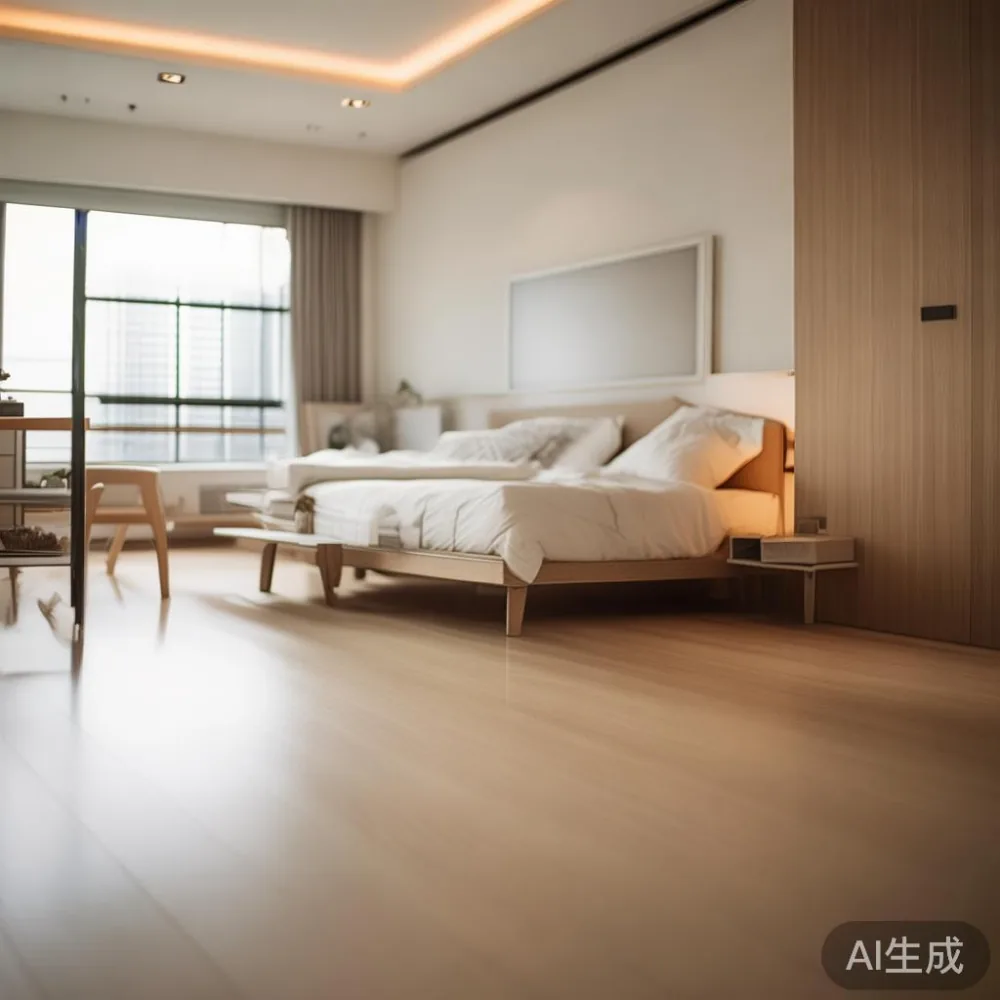
French light luxury is not gold trim and velvet curtains. It is calm colour, short ornament, and one statement piece per zone. In a small bedroom, that usually means a curved-headboard bed frame in soft linen, a marble table as a nightstand, and a single arc floor lamp where ceiling space is tight. The bed frame should sit 10 to 15 cm off the wall, not pushed flush, so you can tuck a slim LED strip behind it and get that soft, ambient glow that reads as quiet, not flashy.
For owners comparing directions, the choice often comes down to a french sofa vs Japandi sofa decision in the living room that mirrors what you do in the bedroom. A french light luxury piece has a 6 cm to 8 cm turned leg, a low back curve, and a fabric with a slight sheen. A Japandi piece sits on a 12 cm to 15 cm straight leg, with a flat back and matte linen. In a 506 sqft Punggol flat, the Japandi line reads more open. In a 689 sqft Bedok condo with a higher ceiling, the french line reads more grown-up. Both work; the room decides.
If you want to push the look further toward modern french provincial furniture, the wardrobe should have a fluted glass panel (8 mm tempered), a slim brass pull (12 cm centres), and a height of 210 cm to 215 cm, not 240 cm. Going to the ceiling looks right on paper and wrong in practice, because you lose the 25 cm to 30 cm of visual breathing room above the unit that makes a small bedroom feel taller.
How to style European sofa in bedroom when the bedroom already has a bed
Here is the honest answer: do not put a full European sofa in the bedroom unless the room is 4.2 m long or more. Instead, repeat the language of the sofa at a smaller scale. A settee 1.2 m wide, on 8 cm turned legs, in the same boucle or velvet as the living room piece, can sit at the foot of the bed as a reading bench. It pulls the eye through the door, ties the two rooms together, and gives you a place to lay tomorrow's outfit without a bulky chair.
For owners asking how to style European sofa in apartment layouts where the bedroom is also a study, the trick is orientation. Angle the settee at 30 degrees into the corner rather than flat against the wall. It opens the path to the wardrobe and gives the bed a soft backrest if you read sitting up. Add a 35 cm round marble table beside it and you have a bedroom design that looks composed, not crowded.
The pieces that quietly signal luxury Mid-century modern furniture - a low walnut nightstand with a single drawer, a slim brass reading lamp, a bench with a curved silhouette - are the same pieces that read well in a small room because their profile is open at the floor. Heavy, floor-skirting furniture swallows light. Furniture on visible legs returns it.
What should I actually buy from a Foshan factory like MIDHILL?
When you buy from a Foshan-based maker such as MIDHILL, you are skipping the Singapore retail markup and getting solid wood, not veneer over MDF. The pieces worth importing for a small 90 bedroom are the ones where the material matters: the bed frame, the dining table (if you have a separate dining zone), and the wardrobe carcass. A bed frame in ash or walnut at 1.6 m long by 1.95 m wide, with a 4 cm thick slat system and a 12 cm leg, weighs around 38 kg to 45 kg. A comparable MDF piece weighs 22 kg. You can feel the difference when you move it, and you will feel it for the next ten years.
MIDHILL's structural warranty runs ten years, they offer lifetime refinishing on solid wood surfaces, and shipping to Singapore is free above US$350 (roughly S$470 at today's rate). Delivery to a Singapore address runs 35 to 50 days by sea, which is worth knowing if you are furnishing a new BTO and the keys are next month. For owners comparing best Italian light luxury furniture showrooms at Tanjong Pagar, the price delta for a solid wood queen bed frame is usually 40% to 55% lower through a Foshan maker, with comparable joinery and a more honest warranty.
One piece I would not compromise on is the nightstand. A small 45 cm by 40 cm unit with one drawer and one open shelf, on a 15 cm leg, in the same wood as the bed frame, will outlast three rounds of decor changes. Avoid the floating nightstand at 35 cm deep. It looks good in photos and fails in practice because the drawer hits the mattress when you open it.
The wardrobe problem in a 3.05 m wall
The single hardest piece to fit in a small HDB master bedroom is the wardrobe. A standard 3-door unit is 200 cm to 220 cm wide and 60 cm deep. That leaves you with 85 cm to 105 cm of wall on either side, which sounds fine until you put a queen bed in the room. The fix is sliding doors, not hinged. A 180 cm wide two-door slider with a 58 cm depth gives you 90 cm of clearance in front, which is the minimum to dress without bumping the bed.
For the interior, two hanging zones (one at 110 cm for shirts, one at 160 cm for dresses) and three shelves of 32 cm height will cover most Singapore wardrobes. Add a single 12 cm deep drawer bank for undergarments. Skip the pull-out trouser rack unless you wear suits daily. Skip the built-in safe unless you actually need one. Both eat depth and add cost.
If your bedroom doubles as a work zone, the wardrobe can take a 45 cm deep desk that pulls out from the side panel. Closed, it looks like a wardrobe. Open, it is a 1.2 m wide desk. This is one of the few tricks I have seen that genuinely adds function without adding footprint.
What about the dining zone, the entryway, and the marble table?
A small Singapore apartment usually combines dining and living. A 1.4 m round solid wood dining table seats four and leaves 80 cm of walking space on every side, which is the bare minimum. A 1.6 m oval table seats six and needs a 1.05 m path. If your living room is under 3.5 m wide, go round. The round edge keeps the path open and there are no sharp corners for a toddler or an elderly parent.
The marble table in the bedroom should be small. A 40 cm round top on a slim 6 mm powder-coated steel base, at 55 cm height, works as a reading table beside the settee we discussed earlier. Marble in a small room needs to be quiet. Carrara with grey veining reads calm. Calacatta gold reads loud. Pick the one your eye can rest on at 11pm, not the one that photographs well for Instagram.
For the entryway, a 1.1 m by 35 cm console on 12 cm legs, with one drawer and a lower shelf, gives you a place to drop keys and a basket for shoes. Skip the full-height shoe cabinet in a small unit. A 90 cm wide two-tier open rack holds eight to twelve pairs and reads open. Closed, the same capacity needs 35 cm of depth and reads heavy.
Light, colour, and the 90-second rule
The fastest way to make a small bedroom feel larger is the 90-second test. Stand in the door with the lights at evening setting (warm 2700K, not cool 4000K) and look at the room for 90 seconds. If your eye lands on three pieces or fewer, the room reads composed. If it lands on seven, the room reads busy, regardless of size. The fix is almost never more furniture. It is removing one piece or moving one piece to a wall.
Colour follows the same logic. A warm white (Benjamin Moore White Dove, Farrow & Ball Wimborne White, or the local equivalent) on three walls, and one wall in a soft, muted tone (sage, putty, dusty blue), reads larger than all-white in a small room. All-white under Singapore evening light reads flat. A single coloured wall reads as depth, and depth is what your eye reads as space.
For flooring, keep one material through the bedroom and the corridor outside. A consistent floor removes the visual seam that breaks a small apartment into smaller rooms. If you must change material at the bedroom door, use a 3 mm flush threshold, not a 12 mm step.
A short list of pieces that earn their centimetre in a small Singapore bedroom
After a few years of doing this, the list of pieces I keep coming back to is short. A queen bed frame in solid ash or walnut, on 12 cm legs, with a curved headboard. Two identical nightstands at 45 cm deep, not floating. A two-door sliding wardrobe at 180 cm wide and 58 cm deep, with a fluted glass panel if you want the french light luxury read. A 1.2 m settee at the foot of the bed in the same fabric as the living room sofa. One 40 cm marble table. One arc floor lamp with a 160 cm reach. One rug at 200 cm by 250 cm, with 30 cm of floor visible on every side.
Add a 1.4 m round dining table in the living zone if your unit has one, and a 1.1 m entryway console. That is the whole inventory for a 506 sqft Punggol flat or a 689 sqft Bedok condo. No more. The room reads larger when the inventory is short because each piece gets to be the right size, in the right material, in the right place.
If you are furnishing a new place and the keys are eight to twelve weeks out, this is also the right window to order from a Foshan maker such as MIDHILL, where sea freight to Singapore runs 35 to 50 days and the warranty starts the day the piece arrives, not the day the showroom sells it to you. Lifetime refinishing on solid wood means the bed frame your child grows up with can be sanded and re-oiled when they leave home, and still be the bed frame your grandchild sleeps in. That is the part of light luxury worth paying for.