Humidity, HDB Flats and Solid Wood: A Singapore Bedroom Design Guide
After fifteen years shipping solid wood furniture from Foshan to apartments in Tampines, Bedok and Punggol, I have learned one quiet truth: the weather in Singapore is harder on a wardrobe than the people who live with it. The numbers say it clearly. Average relative humidity sits between 70% and 85% for roughly 320 days a year, indoor temperatures hover near 28°C, and an HDB corridor in a 12-storey block often measures only 1.2 m wide. Move a 2.0 m solid wood bed frame through that corridor and the geometry of your home starts to matter just as much as the wood grain. This guide is written for anyone planning a bedroom design in a Southeast Asian home, with prices in SGD and room sizes drawn from the flats my colleagues and I have visited over the past year.
Why Singapore's air is the hidden cost of a cheap wardrobe
Wood moves. It swells when it absorbs moisture, shrinks when it releases it, and along the way it can cup, bow, or split at a panel joint. In a Tampines 4-room flat roughly 90 m², a bedroom typically runs 10-12 m² with one window and a single door. Without ventilation, the room's humidity can climb past 80% by 3 a.m. after an air-conditioning cycle ends. A 1.8 m wardrobe built from engineered board with a 0.4 mm veneer will start peeling along the door edges in 14-18 months. A solid wood wardrobe with 18-22 mm stiles and properly kiln-dried stock (moisture content 8-12%) behaves very differently: it dims, takes a small seasonal breath, and stays flat. That is the difference between replacing a bedroom centrepiece at SGD 1,400 and keeping one for 12-15 years.
I saw this first-hand last month when I visited a resale condo in Bedok with my colleague Jianhao. The owner had inherited a 2014 walnut veneer wardrobe from the previous owner. Five panels of the 2.4 m unit had blistered along the top edge, and the air inside read 84% RH on a calibrated hygrometer. Next door, a customer who bought her wardrobe from MIDHILL in 2019 kept a photo album showing the same piece still flush and clean. Same neighbourhood, same weather, completely different outcome.
What relative humidity actually does to a bed frame, a nightstand and a dining table
Engineers talk about EMC, the equilibrium moisture content a piece of wood wants to hold given the air around it. In Singapore, that target sits near 16-19%, well above the 8-12% a kiln-dried board leaves the factory with. The gap between those numbers is the stress your furniture carries every day. On a bed frame, the tell-tale signs are a centre rail that bows by 3-5 mm, slats that no longer sit in their pockets, and a headboard that pulls a quarter inch away from the wall. On a dining table, a 1.6 m solid top will cup so that a coin rolls across it. On a marble table used as a nightstand, the issue shifts from movement to condensation: a cold marble surface in a 30°C room pulls dew from the air and transfers it to the wood legs underneath, which then darken.
The remedy is not heroic. It is a combination of kiln drying, breathable finishes, and a sensible bedroom design that lets air move. Kiln-dried solid wood at 8-12% MC arrives with an EMC deficit that is absorbed within a few humid months, after which it stabilises. A hardwax-oil finish lets the wood release and reabsorb moisture through the surface; a thick polyurethane coat seals that exchange and traps pressure inside, which is why cheap Asian-made wardrobes so often crack at the door rails. The bedroom design part is simple: leave 8-10 cm behind every solid wood wardrobe, keep the AC filter clean so the unit cycles properly, and avoid pushing a 2 m bed frame flat against a non-breathing feature wall.
How do I choose a rattan wicker for a condo?
Pick hand-woven rattan over a kiln-dried solid wood frame with a moisture content between 8% and 12%, sealed joints at every corner, and a vapour-permeable hardwax-oil finish that lets the wood breathe in 80% humidity. Anything else and the rattan will outlast the wood around it, which is the wrong way round.
For a Singapore condo bedroom design, two material stacks work. The first is a walnut solid wood rattan wicker bed frame with a woven headboard panel: walnut is naturally oily and resists damp better than oak or ash, and rattan accepts the same 70-85% humidity range that Singapore rooms throw at it. The second is teak for anything that sits on the floor — teak's silica content repels moisture and shrugs off the occasional mop splash. If the bedroom is small (under 10 m²) and you want one piece of light luxury French styling, a curved rattan-back accent chair in walnut pairs cleanly with a 1.5 m marble table used as a dressing surface, because the cool marble balances the warm weave visually and thermoregulates the items placed on it.
Three checks at the showroom. One, weigh the frame — a 1.8 m walnut bed frame should come in between 55 kg and 75 kg; lighter frames usually hide plywood or MDF inside. Two, ask the sales assistant for the moisture reading on the data sheet; serious exporters such as MIDHILL print it on the spec card. Three, look at the rattan weave under a phone torch for loose ends and uneven tension. A loose weave is a humid-day failure waiting to happen.
Getting a solid wood bed frame, wardrobe or dining table through a Singapore HDB door
Geometry is a customer question I get every week, and it decides whether a beautiful bedroom design survives the lift. A standard HDB passenger lift measures roughly 1.55 m deep by 1.20 m wide by 2.10 m tall, with a 1.0 m wide door. A 2.0 m dining table simply does not fit flat. Service lifts in newer blocks (Punggol, Sengkang) reach 2.4 m by 1.5 m by 2.4 m and save the day, but they are not always available on weekday evenings. The two workable options are flat-pack knockdown joinery or a piece designed slim enough to enter on its side.
Knockdown solid wood designs use mortise-and-tenon or dowel joints that can be assembled in the bedroom in 30-45 minutes. A 1.8 m wardrobe in eight flat panels fits any lift, because the longest single panel is usually 1.65 m. The corridor adds a second puzzle: turns at the lift lobby are tight, often 1.2 m on the inside radius. A 2.4 m side panel will not pivot that corner without either lifting over the railings or being carried vertically for two metres, which is why experienced delivery crews in Singapore charge SGD 80-120 per trip for furniture above 2.0 m. Free shipping over US$350 is common with larger Foshan exporters, which removes the cost but not the choreography.
The dimensions worth memorising before you click "buy": lift door 1.0 m, lift depth 1.55 m, corridor clear width 1.2 m, ceiling height in newer BTOs 2.8 m. A bed frame over 2.1 m will not stand upright under that ceiling on assembly, so the headboard and footboard must ship separately. A nightstand that fits the lift on its side usually measures no more than 0.55 m wide by 0.45 m deep by 0.60 m tall once boxed.
Daily care in 80% humidity without air-conditioning
What about the months when the family turns the system off? A Singapore bedroom design without constant climate control can still protect its furniture. Dehumidifiers sized for a 10-12 m² room (12 L/day class) hold the room at 55-60% RH and cost about SGD 0.35 per kWh to run overnight. Cedar blocks tucked behind the wardrobe absorb a small but real amount of moisture over six months and can be sanded and reused. A thin wool felt pad under each leg of a solid wood bed frame keeps floor moisture from wicking up through the end grain.
Wipe-down habits matter more than most owners realise. A damp microfibre cloth, wrung until it stops dripping, is the right tool. A wet cloth, a spray bottle of all-purpose cleaner, or a steam mop is the wrong one. Dust in Singapore carries fine construction grit that scratches an oiled surface, so a dry dust first, then a barely-damp pass, keeps the patina clean. Light luxury American styling with open-pore finishes rewards this care visibly: a walnut top that is oiled twice a year develops the soft amber glow that the brochures promised on day one.
A bedroom design budget in SGD that still feels like light luxury
Mid-tier HDB buyers can spend less than SGD 6,500 on a complete bedroom set and still get solid wood construction. A reference layout for a 12 m² master bedroom runs along these lines:
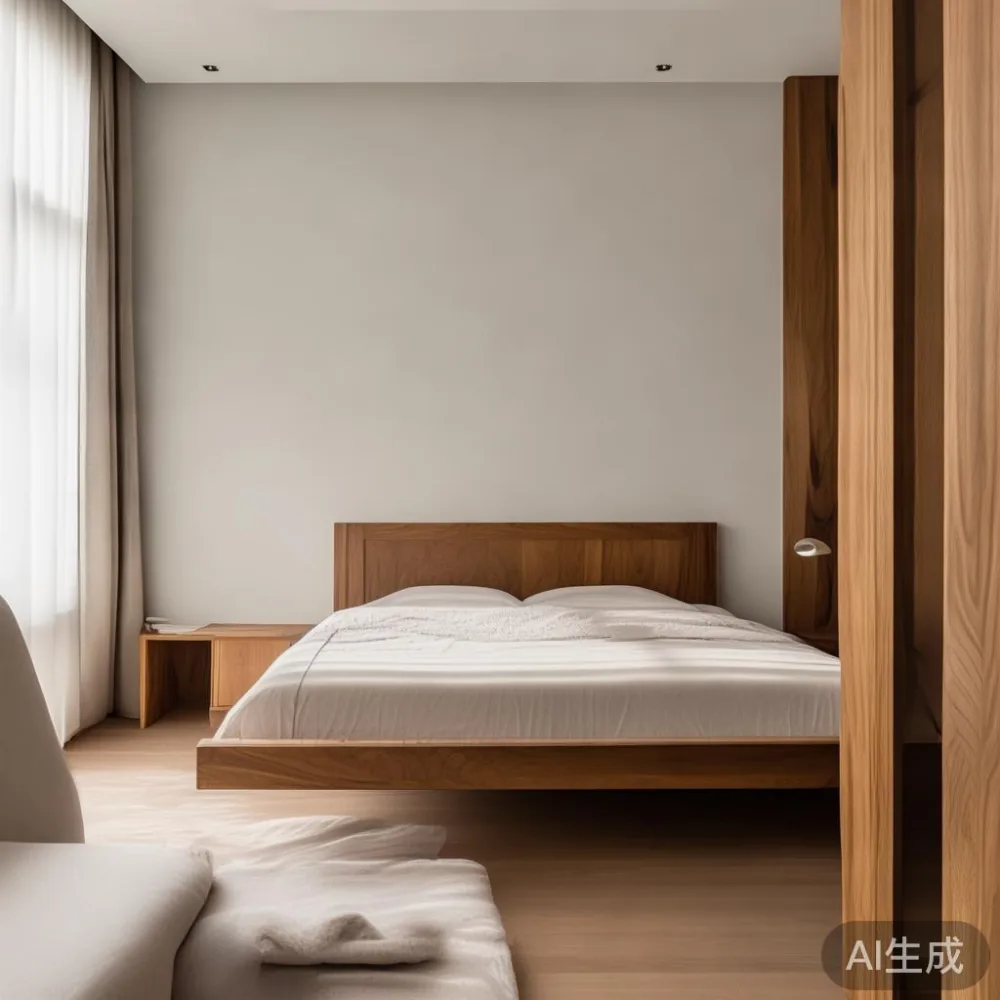
- 1.8 m walnut solid wood bed frame with rattan headboard panel: SGD 1,800-2,400
- 2.0 m three-door solid wood wardrobe with soft-close hinges: SGD 2,200-2,800
- Two matching walnut nightstands with drawer: SGD 600-800
- 1.2 m marble table converted into a dressing surface: SGD 700-1,100
- 1.5 m solid wood dining table for two in the adjacent living area: SGD 1,000-1,400
GST at 9% adds around SGD 285 on a SGD 6,300 order, and a 14-day return window covers the small risk that a panel does not match the rest of the room. A 10-year structural warranty through the exporter is the deeper safety net, especially for the bed frame and wardrobe, which take the most daily punishment.
Three small habits that protect a S$2,000 wardrobe for fifteen years
First, level the piece within 2 mm across its full length. An unlevel wardrobe loads its doors unevenly, the hinges warp, and within nine months the doors no longer close cleanly. Second, leave a 4 cm gap behind the unit to the wall so air can move; this is the single cheapest improvement in any bedroom design. Third, refinish the exterior faces with hardwax oil every 18-24 months; a S$45 tin of oil and an hour of work is the difference between a wardrobe that looks tired at year five and one that still photographs well at year fifteen.
If you live in a Punggol WaterwayHeight unit with full-height windows facing south, consider motorised sheer blinds to filter the afternoon sun. UV light greys walnut and darkens teak unevenly, and a blind that drops automatically between 1 p.m. and 4 p.m. reduces that damage by roughly half. None of these measures feels dramatic on its own, yet stacked together they are what separates a bedroom design that ages into patina from one that quietly falls apart behind the bedroom door.