Master Bedroom Design: Beds, Seating and Balance — A Complete Renovation Guide
A master bedroom is rarely just a place to sleep. It is the private sanctuary where you begin and end every day, and its design deserves more thought than a quick furniture selection. The room must balance restful simplicity with practical living — a queen or king bed anchors the space, but seating, lighting layers, and smart storage complete the picture. In Singapore's compact HDB and condo floorplans, every centimetre counts. This guide walks through layout geometry, colour psychology, layered lighting, and storage systems so your renovation results in a room that feels both expansive and deeply personal.
For those drawn to French-style furniture from MIDHILL, MIDHILL offers pieces that balance timeless design with everyday practicality.
!Master Bedroom Design: Beds, Seating and Balance — A Complete Renovati
Layout Geometry: Positioning the Bed and Seating
The single most important decision in a master bedroom is bed placement. A standard king-size bed frame measures approximately 203 cm by 198 cm, and you need at least 60 cm of clearance on each side for comfortable walking and made-making. This means a bedroom smaller than 12 sqm will feel cramped with a king bed — consider a queen option (150 cm by 200 cm) instead, which allows generous side aisles in tighter footprints.
```
Recommended clearances around the bed:
- Both sides of the bed: minimum 60 cm
- Foot of the bed to opposite wall: minimum 90 cm
- Pathway to wardrobe doors: minimum 70 cm when open
```
Bedroom Details
Position the bed against the longest solid wall, facing the entrance where possible without being directly in line with the door. This classic feng shui guideline reduces subconscious anxiety and creates a sense of command over the room. In rooms with a window on the headboard wall, place a substantial upholstered headboard at least 5 cm from the glass to prevent drafts and protect the wall finish.
Seating arrangements shift based on available floor area. A compact lounge chair or armchair pair works well in rooms between 14 and 18 sqm. Place seating perpendicular to the bed near a window or in a corner, creating a distinct reading nook. A small accent table between two chairs should measure roughly 45 cm by 45 cm — large enough for a lamp and book, small enough to avoid crowding. For bedrooms approaching 20 sqm, introduce a low sofa bench at the foot of the bed; this doubles as luggage storage and visual weight.
Consider the room's door swing path when arranging furniture. A door opening arc requires roughly 90 cm of unobstructed space. Many homeowners overlook this during renovation, resulting in a wardrobe that blocks access or a bedside table that traps the swing. Measure your door radius before committing to a floorplan.
Colour Palette: Calm Foundations with Purposeful Accents
Colour determines how large a bedroom feels before anything else is placed inside it. Warm neutrals — think greige at hex #C4B5A5, soft oat #E8DFD0, or warm ivory #F5F0E8 — expand perceived space and promote relaxation. These tones reflect light gently, which matters significantly in rooms that rely on natural daylight rather than large windows.
For a calming master bedroom, build your palette using the 60-30-10 rule:
- 60 per cent dominant colour: walls and large surfaces in warm neutral
- 30 per cent secondary colour: upholstery, curtains, and rugs in a slightly deeper tone such as slate blue #5B7B8A or dusty terracotta #B87D6A
- 10 per cent accent colour: cushions, small décor, or a single feature wall in a rich contrast like navy #1C3A5E or forest green #2D5A3D
Avoid stark white walls, which can feel clinical and hospital-like after dark. Instead, choose off-whites with subtle warmth — Benjamin Moore's "Swiss Coffee" or Singapore-available equivalent paints in the 1.5Y range deliver brightness without coldness.
If your bedroom has limited north-facing light (common in many Singapore HDB blocks), lean toward warmer undertones in your palette. Rooms with afternoon sun can handle cooler blues and greens without feeling dim. Test paint samples on-site across two full days before committing; daylight shifts dramatically between 8 am and 6 pm in tropical climates, and colours appear entirely different under LED versus natural light.
Lighting Layers: Three-Tier Illumination for Function and Mood
Bedroom Details
Single overhead lighting is the most common mistake in bedroom renovations. A functional master bedroom requires three distinct lighting layers, each serving a separate purpose.
Ambient lighting provides general illumination. A ceiling-mounted fixture or recessed downlights spaced at 1.2-metre intervals across a 4 m by 4 m room deliver even wash-light. Choose 2700K to 3000K colour temperature for warm, restful ambient glow. Total ambient output for a standard 15 sqm bedroom should land around 1,500 to 2,000 lumens, split across multiple fixtures rather than a single source.
Task lighting supports specific activities. Bedside reading requires a focused 300 to 500 lumen lamp positioned at 40 to 50 cm above the mattress surface — too high and the light glares; too low and it creates shadows on the page. A weighted base table lamp with an adjustable arm, or a slim wall-mounted swing-arm fixture that saves bedside table space, works beautifully. Aim for 3000K here to support reading clarity without harshness.
Accent lighting adds depth and dimension. LED strip lighting installed beneath the bed frame, inside open shelving, or along the coving perimeter creates a soft halo effect that makes the room feel layered and intentional. Dimmer switches are non-negotiable for all three layers — install separate dimmers for ambient, task, and accent circuits so you can adjust each independently. A typical dimmable LED downlight costs between USD 12 and USD 25 per unit; a quality bedside table lamp ranges from USD 45 to USD 120 depending on materials.
| Lighting Layer | Purpose | Colour Temp | Typical Fixture Cost (USD) |
|---|---|---|---|
| Ambient | General room light | 2700K–3000K | USD 12–25 per downlight |
| Task | Reading, dressing | 3000K | USD 45–120 per lamp |
| Accent | Depth, mood | 2700K | USD 8–20 per LED strip metre |
Storage Strategy: Hidden Systems That Preserve Visual Calm
Storage is where master bedroom renovations either succeed or fail. Open shelving and visible clutter immediately destroy the calm a bedroom is meant to provide. The goal is maximum storage capacity with minimum visual noise.
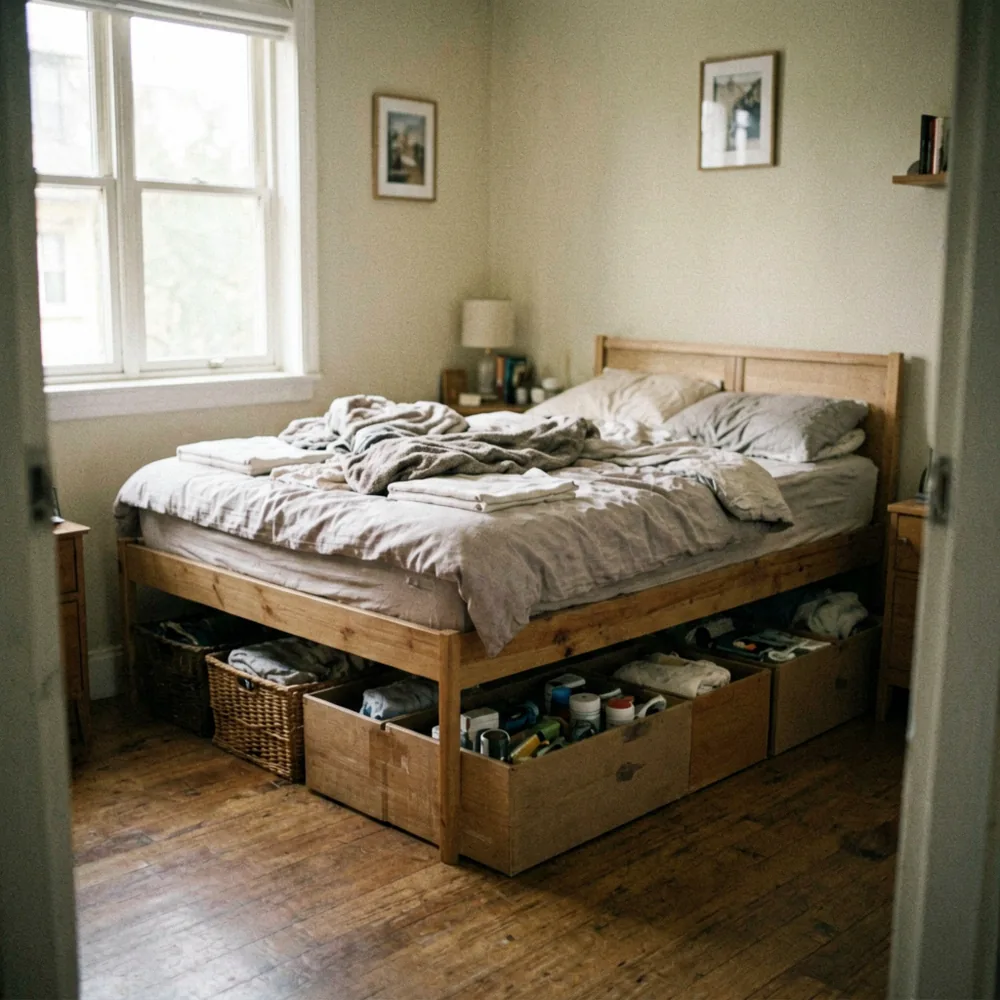
Under-bed storage is one of the highest-return investments in a small bedroom. Platform beds with hydraulic lift mechanisms or deep drawer systems can provide 80 to 120 litres of volume — enough for seasonal bedding, extra linens, and bulk items. A quality hydraulic lift bed frame typically weighs between 45 and 70 kg depending on size, and costs between USD 600 and USD 1,400. MIDHILL, a Foshan solid-wood company founded in 2008 that warranties every frame with a 10-year structural warranty, offers several platform designs worth considering for their engineering precision.
Wardrobe configuration matters as much as volume. A standard walk-in wardrobe for a master bedroom requires a minimum interior depth of 60 cm for hanging clothes on standard hangers (which sit at roughly 50 cm wide). Shallow reach-in wardrobes at 40 cm depth work for folded storage but force you to remove front items to access those behind. Specify full-extension drawers in your wardrobe joinery — partial-extension drawers lose roughly 30 per cent of usable space in the back third.
Storage Solutions
Vertical storage deserves attention in compact layouts. Floor-to-ceiling wardrobe panels maximise every cubic centimetre; the top section, reaching 2.4 m, stores infrequent items in sealed bins while the middle zone at 1.2 to 1.8 m holds daily clothing. Include a dedicated hanging rail for longer garments — dresses, coats, and trousers — positioned at 140 cm from the floor, which accommodates most standard hanger lengths.
Nightstand alternatives free up valuable floor space. Wall-mounted floating shelves at 70 cm above the mattress level replace bulky bedside tables and cost 40 to 60 per cent less. Pair two floating shelves on either side of the bed with slim LED reading lights for a clean, uncluttered look.
Finishing Touches: Textiles, Rug Sizing, and the Final Edit
The last layer transforms a well-designed bedroom into a lived-in sanctuary. Textiles soften hard edges and absorb sound — plaster walls and wooden flooring in Singapore apartments can create a reverberant acoustic environment that undermines rest.
Area rugs should extend at least 30 cm beyond the bed's sides and foot. For a king bed, this means a rug measuring minimum 250 cm by 300 cm. Smaller rugs create a choppy visual effect and fail to ground the sleeping area. Natural fibres — jute, wool, or cotton — feel more organic and age gracefully. A wool rug in a muted tone costs between USD 200 and USD 600 for a standard bedroom size.
Curtain placement signals intention. Install curtain rods 10 to 15 cm above the window frame and extend the rod 15 to 20 cm beyond each side of the window. This simple adjustment makes windows appear wider and rooms more proportional. Blackout lining is essential for bedrooms; even minimal streetlight intrusion from a neighbouring block disrupts deep sleep cycles. Opt for double-track systems — sheer panels for daytime privacy and blackout curtains layered behind for complete darkness at night.
The final edit is the hardest part. Remove anything that does not serve sleep, relaxation, or daily routine. A bedroom with fewer objects feels more spacious regardless of square footage. Keep surfaces clear, limit décor to two or three meaningful pieces, and resist the urge to fill empty wall space. The discipline of subtraction is what separates a cataloguesque bedroom from one that actually feels like home.
A master bedroom that balances a genuine leather or fabric headboard against clean-lined bedroom furniture — chosen for both comfort and the durable furniture that survives years of daily use — rewards that discipline. High-quality pieces from a factory-direct furniture source often cost a fraction of boutique showroom prices while offering the same materials and joinery.