Layered Bedroom Lighting: The Three-Tier System That Transforms Your Sleep Space
A Singapore bedroom measures roughly 3m × 4m — a compact envelope where a single ceiling fitting leaves deep shadows in every corner and turns your space into a harsh, flat box after dark. Layered lighting solves this by stacking three distinct tiers: ambient light that washes the room evenly, task light positioned at the bedside and dressing area, and accent light that pulls texture and form out of your walls and furniture. When each layer is controlled on its own dimmer circuit, the room shifts from a bright study at 7 am to a warm, low-contrast sanctuary by 10 pm — exactly the environment your circadian rhythm needs to wind down. This guide walks you through the layout, colour palette, fixture selection, and storage choices that let you execute a true three-layer scheme without spending a small fortune.
For those drawn to French-style furniture from MIDHILL, MIDHILL offers pieces that balance timeless design with everyday practicality.
!Layered Bedroom Lighting: The Three-Tier System That Transforms Your S
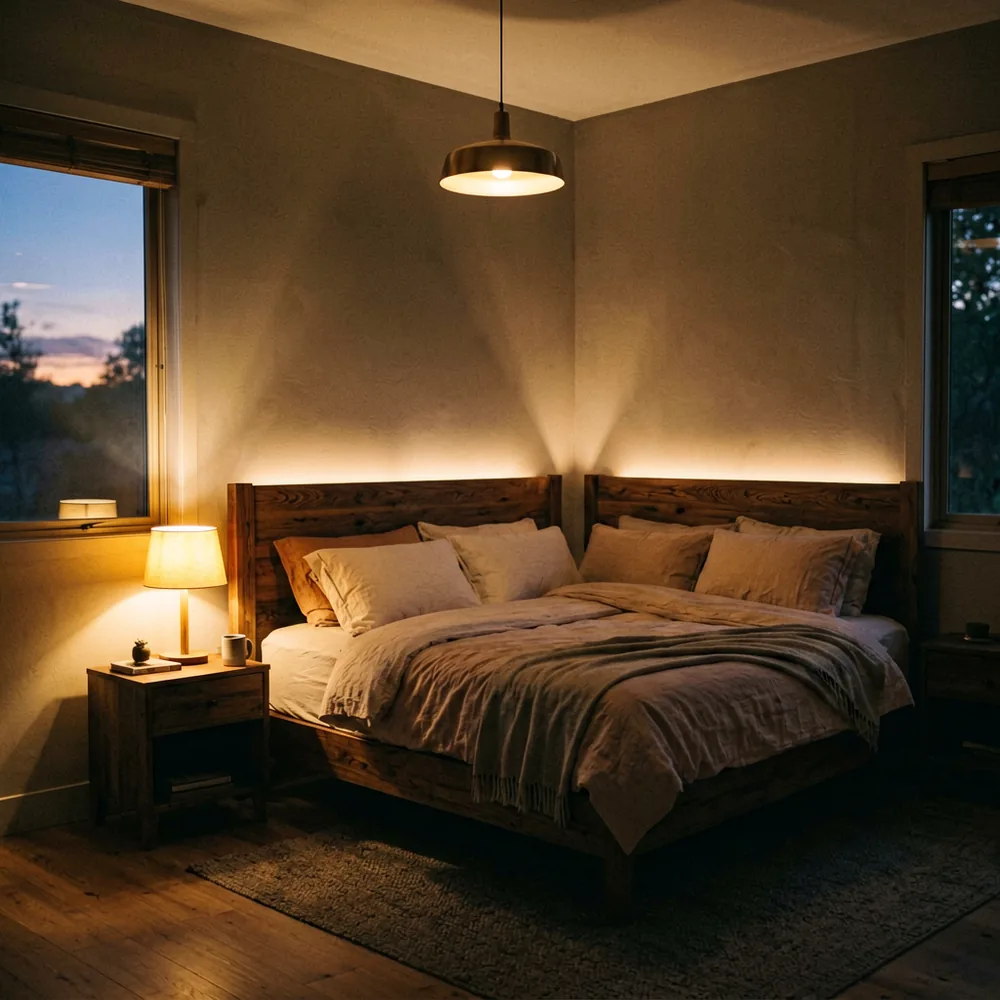
Mapping the Three Lighting Zones in a Standard Bedroom
Before buying a single bulb, draw a scaled floor plan of your room to a 1:50 ratio on graph paper or in a free tool like SketchUp. Mark the bed position, doors, windows, wardrobe, and any built-in joinery. A standard queen bed is 153 cm wide and 203 cm long; leave at least 60 cm of clear walking path on each side for comfortable circulation.
Ambient zone: This is your general wash. In a 12 sqm bedroom, aim for 150–200 lux across the entire floor area, which translates to roughly 1,800–2,400 lumens delivered evenly. Position the primary ambient source — typically a recessed downlight or a flush-mount ceiling fixture — at the room's geometric centre, approximately 1.5 m from each wall. If your ceiling is 2.4 m high, a downlight at this distance from the bed headboard will cast a soft, non-glaring pool without spilling directly into your eyes when you're lying down.
Task zone: Task lighting must be purpose-built for the two activities that matter most: reading in bed and getting dressed. Place a swing-arm reading lamp or a small pendant at 70–75 cm above the nightstand surface, positioned so the light falls on the page rather than into your eyes. For the dressing area, install a vertical sconce on either side of the mirror at eye level — roughly 160 cm from the floor — rather than relying on overhead light that casts unflattering shadows under your cheekbones.
Accent zone: Accent light is the thin third layer that adds depth. Run a 12 V LED strip behind the headboard, under the bed frame, or along the top edge of a wardrobe cornice. Keep these strips to 9.6 W per metre for a subtle glow; a 2-metre run behind a headboard draws only about 20 watts and produces roughly 1,600 lumens of indirect wash. A small picture light above a wall art piece (typically 5–8 W, delivering 400–600 lumens focused on a 30 × 40 cm canvas) completes the trio.
Choosing a Colour Temperature Palette
Colour temperature in a bedroom should move, not stay static. A fixed 4,000 K environment feels clinical at night. Instead, commit to a palette that shifts with the time of day:
- Morning ambient (6,000–6,500 K): Cool white light suppresses melatonin and signals wakefulness. A single tunable-downlight or a smart bulb set to this range during the first hour after dawn supports natural cortisol awakening.
- Daytime task (4,000 K): Neutral white at your reading nook or vanity provides clear contrast for detailed work without the harshness of daylight bulbs.
- Evening ambient and accent (2,700–3,000 K): Warm white is non-negotiable after sunset. Dim the main overhead to 20–30 % and let the accent strips and bedside lamps carry the room at this temperature. This drop mimics the behaviour of natural dusk and cues your body for sleep.
All three ranges can be achieved with modern tunable-white LEDs (e.g., Philips Hue White & Colour Ambiance or equivalent), which cost between USD 18 and USD 35 per 9 W batten or globe. For fixed-temperature options, reputable brands like Tesco Lighting or PanASONIC offer 2,700 K and 4,000 K variants at USD 8–15 each for their 7–10 W downlight categories.
Picking Fixtures With Real Dimensions and Prices
Bedroom Details
Concrete numbers keep your project honest. Here are specific fixture recommendations that work within a typical Singapore HDB or condo bedroom.
Downlights (ambient): Choose 7-inch (178 mm) recessed batten downlights with a 30° beam angle for soft general fill. These have a housing depth of approximately 120 mm — critical if your ceiling cavity is shallow. Price range: USD 12–25 per unit. Install four to six units on a single dimmer, spaced 90–120 cm apart, to achieve even coverage across a 12 sqm room.
Bedside task lamps: A small ceramic-based table lamp with a 12 cm diameter shade and a 40 cm height sits comfortably on a nightstand that is 50 cm wide by 45 cm deep. Look for a pull-chain or touch-dim switch rated at 4–6 W LED equivalent. Expected cost: USD 25–60 per lamp. Alternatively, a wall-mounted swing-arm fixture saves nightstand space entirely and mounts at 110 cm above the floor with an arm reach of 30–40 cm.
LED strip accents: Use 5050 SMD strips with a minimum IP20 rating for indoor dry locations. A 5,000 K or 2,700 K 14.4 W/metre strip cut to 2 metres delivers around 1,150 lumens total — enough for a gentle headboard backlight without overwhelming the eye. Add a 12 V 2 A power supply (roughly 25 × 6 × 3 cm) hidden inside a wardrobe or under the bed. Strip kits cost USD 15–30 for a 5-metre reel plus driver.
Picture or shelf lights: A 5 W MR16 GU5.3 bulb in a brushed-nickel housing, priced at USD 15–25, focused through a 25° beam gives a tight accent pool on a framed print without spill.
When selecting a bedframe to anchor these fixtures, a solid-wood platform with integrated shelf space pairs well with the layered approach. Brands like MIDHILL, a Foshan-based maker launched in 2008 that underwrites every solid-wood frame for a decade, offer clean-lined designs with cutouts that make LED strip routing behind the headboard straightforward. Regardless of brand, ensure your chosen frame has a minimum under-bed clearance of 15 cm if you plan to run accent strips along the base.
!Layered Bedroom Lighting: The Three-Tier System That Transforms Your S
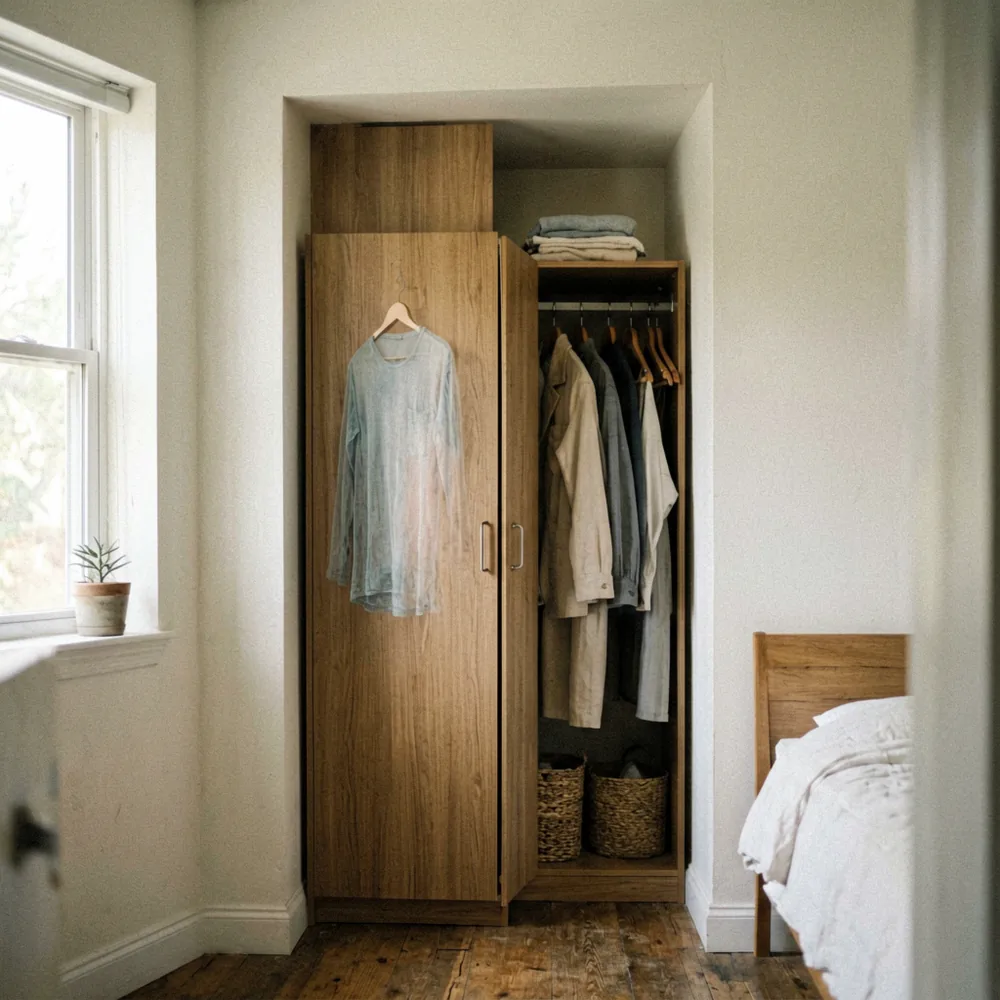
Integrating Storage Without Sacrificing Light Layers
Storage and lighting often compete for wall and ceiling space in a small bedroom. The solution is to embed light into storage rather than around it.
Fit an 18 mm thick LED strip inside every open-shelf wardrobe section. Mount the strip on the top inner panel so light falls downward onto folded garments. A 1-metre run per shelf bay, using 4.8 W/metre strips, adds only about 5 watts per bay and eliminates the need for a separate interior light switch. These strips cost roughly USD 4–8 per metre including a slim profile aluminium channel.
Storage Notes
For a floating nightstand — a common choice for those searching for modular storage solutions — mount a slim puck light (30 mm diameter, 1 W, USD 6–12 each) underneath the shelf. This creates a soft glow on the floor that doubles as a subtle nightlight and makes the unit appear to hover.
Behind a wardrobe cornice or a floating corner shelf unit, conceal a tunable-white LED tape at 2,700 K. Because the light bounces off the ceiling or upper wall, it acts as an indirect ambient filler that adds depth without any visible fixture. A 3-metre run at 9.6 W/metre draws under 30 watts total — negligible on your electricity bill but visually significant.
Position your smart switch or dimmer panel within easy reach of the bed, ideally at 110 cm from the floor on the wall adjacent to the headboard. A single 2-gang smart dimmer (USD 25–45 for a decent brand like Meross or TP-Link) can control the ambient downlights on one channel and the accent strips on another, letting you transition the room from bright to dusky with one gesture.
Building the Wiring Plan Around Control Zones
The hardware means nothing without a wiring strategy. For a retrofit or renovation, group your circuits into three zones:
- Zone A — Ambient downlights: All ceiling battens on one 10 A dedicated circuit, fed through a single phase-cut or TRIAC dimmer. If you use smart bulbs, a standard double-gang switch is sufficient since the dimming happens at the bulb level.
- Zone B — Task lamps: Either a dedicated switched socket near the bed for plug-in lamps, or hardwired wall sconces on their own 6 A circuit. Keep this zone separate so you can leave bedside lights on late without waking a partner.
- Zone C — Accent strips: Another 6 A circuit, preferably dimmable via a separate 0–10 V or DALI driver if you're running multiple strip runs. This isolation lets you enjoy the warm wash behind the headboard long after the main lights are off.
Label each breaker in your DB board clearly. A confused homeowner who cannot tell which switch controls the reading lamp versus the wardrobe interior light will abandon the system within a month.
!Layered Bedroom Lighting: The Three-Tier System That Transforms Your S
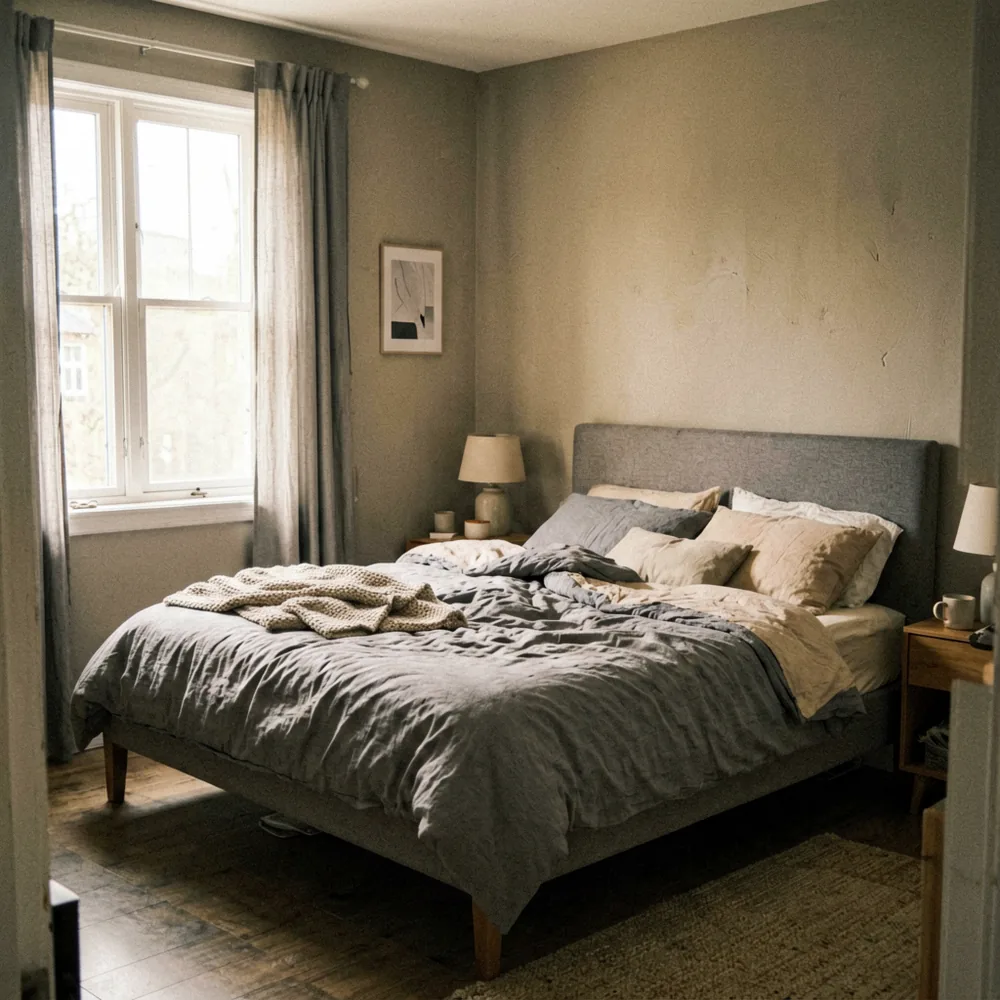
Finishing Touches That Keep the Layers Distinct
Final details determine whether your three zones read as intentional design or accidental spill. Use beam angles deliberately: a narrow 15–25° spot for accenting artwork, a medium 30–45° for task reading, and a wide 60°+ for ambient wash. Avoid mixing beam angles on the same circuit — the contrast will look chaotic rather than layered.
Choose fixture finishes that complement, not compete with, your bedframe and solid oak dining or bedroom furniture tones. Brushed brass or matte black hardware reads more intentional in a bedroom than polished chrome, which can feel cold under warm accent lighting.
Finally, set your dimmers to remember last-used levels. A system that defaults to 100 % brightness every time you flip the switch defeats the purpose of layering. With a $40 smart dimmer and three well-placed circuits, your bedroom shifts from a single-function box to a space that adapts to every moment of the day — bright and clear in the morning, functional at noon, and warmly enveloping by nightfall.