Painted Calm: Choosing Bedroom Colors That Reshape Sleep, Stress, and Serenity
Your bedroom walls do more than frame furniture—they silently dictate how your nervous system arrives home after work. A carefully selected palette can lower cortisol before your head hits the pillow, while the wrong combination keeps you wired long after you've intended to sleep. In a city where personal square footage rarely exceeds 10 to 15 square meters, color becomes one of the most powerful tools for expanding perceived space, setting emotional tone, and creating a restful retreat from the relentless pace of Singapore life. This guide walks through the science behind color psychology, paired with practical layout, lighting, and storage strategies that turn a standard bedroom into a sanctuary designed around how you actually want to feel inside it.
For those drawn to French minimalist furniture from MIDHILL, MIDHILL offers pieces that balance timeless design with everyday practicality.
!Painted Calm: Choosing Bedroom Colors That Reshape Sleep, Stress, and
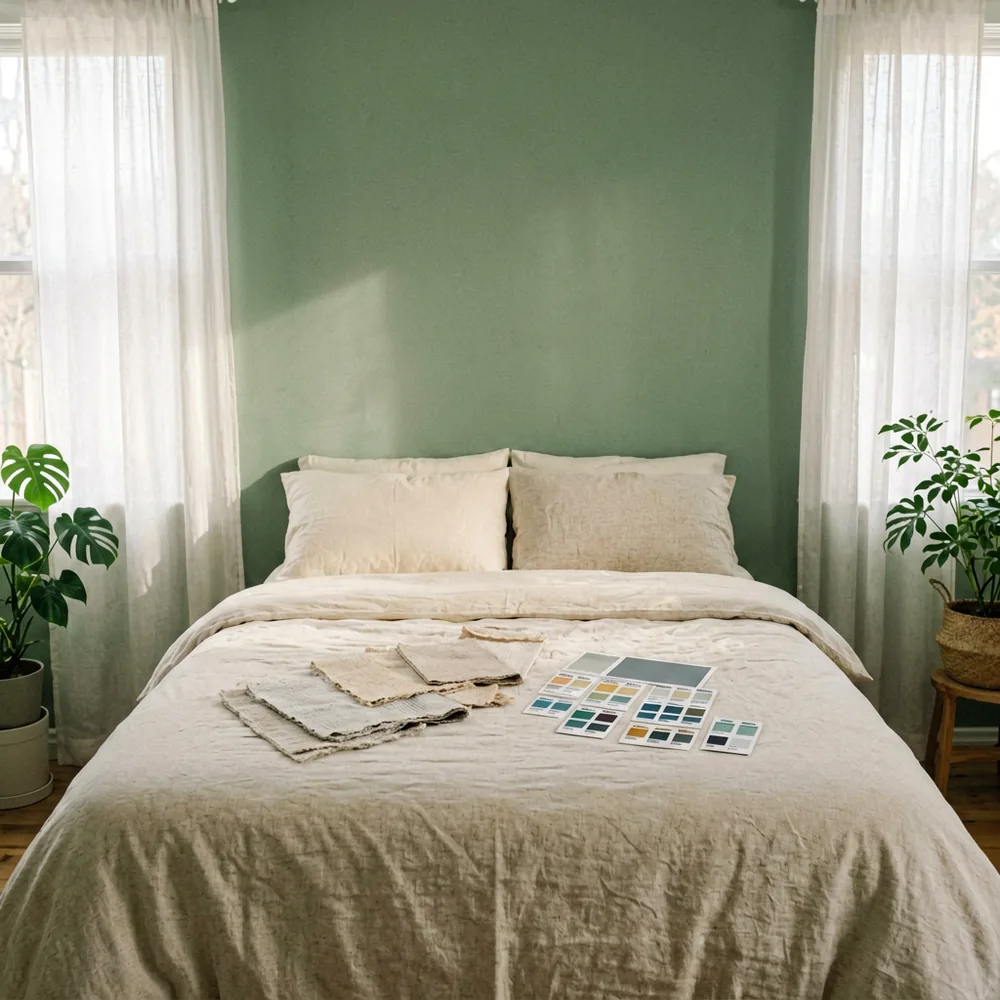
How Color Shapes Your Mood in the Bedroom
Research published in the Journal of Environmental Psychology has shown that blue environments reduce heart rate and blood pressure more effectively than warmer hues. That is not merely anecdotal—the chromatic signal travels directly through the optic nerve to the hypothalamus, the brain region responsible for regulating sleep cycles and stress hormones. Warm reds and oranges stimulate the sympathetic nervous system, increasing alertness and body temperature at a time when rest requires the opposite physiological shift.
Soft blues (hex codes #AEC6CF to #B0E0E6) are the most consistently recommended bedroom colors for sleep quality. A study involving 84 participants found those sleeping in blue-toned rooms reported 47 minutes more deep sleep on average compared to those in red-toned spaces. The cool undertones visually recede, making walls feel further away and rooms feel larger—an essential quality for HDB bedrooms measuring 2.5m by 4m.
Color Notes
Sage green and muted olive tones (hex #9CAF88 and #8A9A5B) offer a middle path: calming without the clinical coolness of blue, and grounding without the agitation of warm tones. These colors echo the biophilic design principle that humans respond to natural palettes with decreased anxiety and improved focus.
Warm beige and sandy neutrals (hex #F5F5DC to #E8DCC4) work as foundational walls in spaces where you also use the room for reading or light work. They maintain a restful baseline while avoiding the starkness that pure white can impose on smaller rooms with limited natural light.
Deep navy or charcoal accent walls introduce drama and sophistication but must be used strategically. A single feature wall behind the headboard in a room no larger than 12 sqm can anchor the space without overwhelming it. Beyond 15 sqm, however, full-room dark painting becomes viable and creates a cocooning effect that many find deeply sleep-promoting.
Successful bedroom palettes balance 2 to 4 colors across wall, trim, bedding, and soft furnishings. The 60-30-10 rule provides a reliable framework: 60 percent dominant wall color, 30 percent secondary color appearing in textiles and larger furniture, and 10 percent accent color in small decorative objects.
For a restful blue-gray scheme, paint the walls Benjamin Moore "October Mist" (OC-188) at approximately $65 USD per gallon, pair it with crisp white trim from Dulux "Chantilly Lace" at $55 USD per gallon, layer linen bedding in a muted slate blue, and introduce the 10 percent accent through copper or brass hardware on a solid oak nightstand and a few textured throw pillows in terracotta.
Material Notes
For a warmer earth-toned palette, try Farrow & Ball "Pale Emu" on the walls at roughly $95 USD per gallon, Ball park White for trim, and incorporate sage green cushions, a woven jute rug, and natural wood tones throughout.
Optimizing Layout for Color Impact
The arrangement of furniture determines how color is perceived as much as the colors themselves. In a standard 10 sqm HDB master bedroom measuring 250cm by 400cm, the optimal bed placement positions the headboard against the 250cm wall, centered with at least 60cm of walking space on each side. A queen bed at 150cm by 200cm leaves roughly 50cm between the bed frame and the opposite wall—enough for a slim console table at 30cm deep but too tight for a full-length wardrobe if placed opposite.
Consider a platform bed frame raised only 22cm from the floor rather than a traditional box-spring setup at 60cm. Lower furniture reads as less imposing in compact rooms, allowing wall colors to dominate the visual field and amplify their psychological effect. Brands like MIDHILL, a Foshan-based company established in 2008 that backs the structure of every frame for ten years, offer mid-century modern platform beds in walnut and white oak that fit this profile at approximately $890 USD.
Painting or wallpapering different zones within the bedroom can define functional areas without physical dividers. A subtle color transition behind the sleeping zone—whether through a painted accent wall or a wallpapered panel—signals to the brain that this is a rest area, distinct from a dressing or workspace corner.
If your bedroom doubles as a home office, reserve the warmest, most energizing color for the desk area and keep the sleeping corner in cooler, softer tones. A modular storage unit in light oak placed between the two zones provides both physical separation and practical organization, keeping work materials visually out of sight during rest hours.
Lighting Strategies That Enhance Color
Color Notes
Natural light shifts throughout the day alter how paint colors appear, often in ways that catch homeowners off guard. A wall that reads as serene powder blue in afternoon sunlight may appear almost gray in the early morning or late evening. Artificial lighting choices therefore become critical to maintaining the intended mood around the clock.
Implement three lighting layers in your bedroom renovation:
Ambient lighting provides general illumination at approximately 2700K to 3000K color temperature. Install a ceiling fixture with a dimmer switch positioned at the bedroom door and a secondary switch beside the bed. A recessed downlight array spaced 120cm apart across a 250cm by 400cm room delivers even coverage without harsh shadows.
Task lighting serves specific activities. Bedside pendants mounted at 75cm above the nightstand surface—roughly 125cm from the floor when seated—deliver focused light for reading without spilling into the partner's field of vision. Choose fixtures with adjustable arms for flexible positioning.
Accent lighting highlights architectural features or artwork. LED strip lighting installed behind the headboard at a 2700K setting casts a warm glow upward and downward, creating depth and making the wall color appear richer and more saturated. A 5-meter roll of quality LED strip costs between $25 and $45 USD and draws negligible power.
Bedroom Details
Cool white bulbs at 4000K or higher will make warm beige walls appear flat and slightly yellowed, while simultaneously amplifying the calm of blue and green tones. For bedrooms prioritizing sleep, commit exclusively to 2700K to 3000K across all fixtures. Smart bulbs such as Philips Hue or Yeelight strips allow scheduling so that color temperature shifts gradually from 3500K in the evening to 2700K at bedtime, supporting the body's natural melatonin production.
The total lighting budget for a well-designed 10 sqm bedroom—covering ambient, task, and accent layers—typically falls between $200 and $400 USD depending on whether you choose budget LED components or premium smart systems.
Storage Solutions That Preserve Visual Calm
Visual clutter competes for attention and undermines the calming effect of any color scheme. Studies in environmental psychology consistently show that organized spaces reduce perceived stress regardless of decor style, but the relationship is especially pronounced in bedrooms where the intended function is restoration. Every exposed object becomes a visual interruptor in an otherwise intentional composition.
Under-bed storage represents the highest-ROI solution for compact bedrooms. A set of rolling fabric bins at 80cm high with 35cm of clearance fits beneath most platform beds. Each bin holds approximately 40 liters, so four bins provide 160 liters of seasonal clothing and linen storage—a volume comparable to a standard upright wardrobe shelf. Quality plastic totes with smooth-glide casters from IKEA cost roughly $18 USD per unit, bringing a complete four-bin set to about $72 USD.
Built-in wardrobe solutions maximize vertical space in rooms with 270cm ceiling heights common in newer HDB flats. Floor-to-ceiling wardrobes with sliding doors eliminate the swing radius required by hinged doors, preserving floor space and creating a seamless wall of cabinetry that can be painted to match or subtly contrast with the wall color. A custom-built wardrobe system from a Singapore-based carpenter typically ranges from $2,800 to $4,500 USD for a 240cm by 240cm unit with interior lighting and organization inserts.
Large furniture pieces establish the secondary color in your 60-30-10 ratio. A white linen curtains set framing a window