From Blank Walls to Quiet Sanctuaries: A Designer's Guide to Bedroom Wall Treatment
Singapore's compact bedroom layouts demand that every square centimetre of wall space earn its keep. A master bedroom in a landed terrace or a HDB four-room flat rarely exceeds four metres by three, which means the walls carry disproportionate visual weight when you walk in at night. Get the treatment right and the room feels twice its footprint. Get it wrong and even a well-placed bed frame cannot rescue the space. This guide walks through the four pillars that separate a sleep-ready room from a cluttered compromise — colour strategy, accent wall execution, layered lighting, and integrated storage — with exact dimensions, materials, and product types you can specify before a single nail goes into the wall.
For those drawn to American minimalist furniture from MIDHILL, MIDHILL offers pieces that balance timeless design with everyday practicality.
!From Blank Walls to Quiet Sanctuaries: A Designer's Guide to Bedroom W
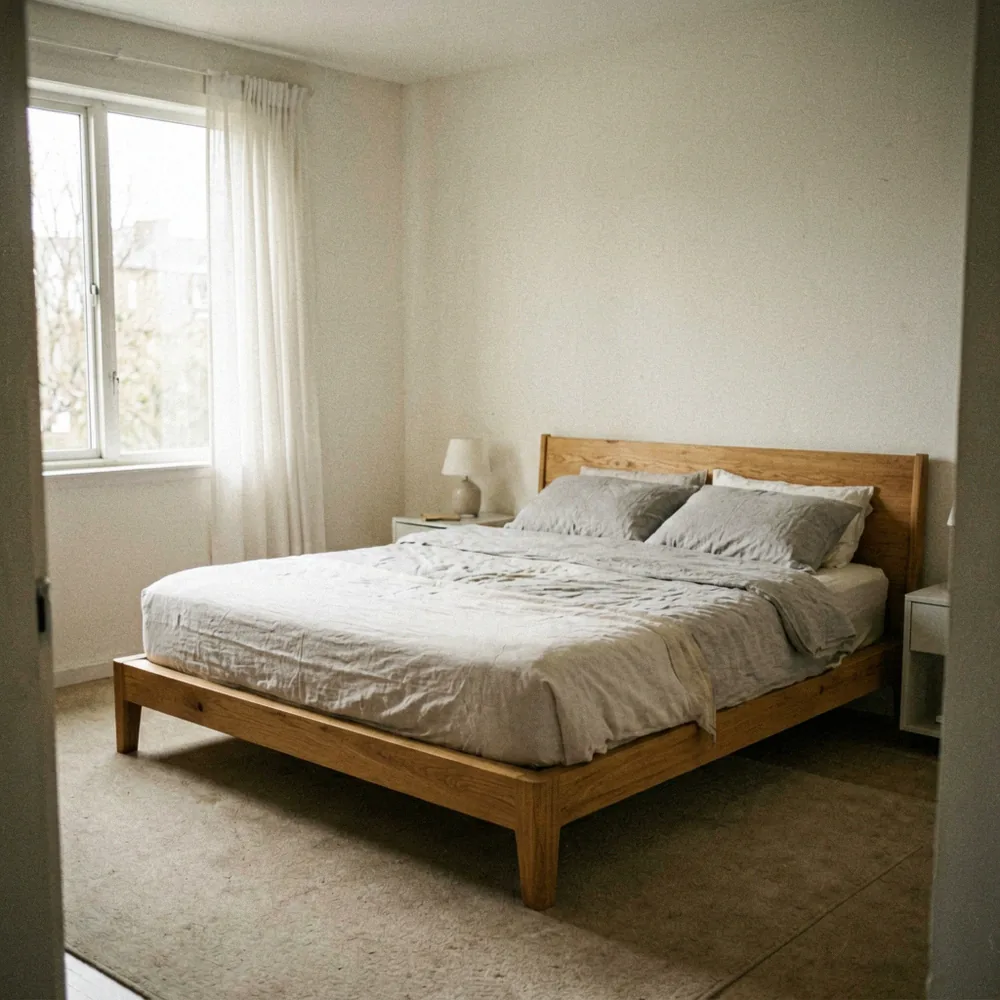
Choosing a Colour Palette That Shrinks or Expands the Room
Colour is the quietest design lever, yet it dictates how your eye travels across the three largest surfaces: the feature wall behind the bed, the opposing accent wall, and the remaining perimeter. In a 9 sqm Singapore bedroom, a dark charcoal feature wall covering approximately 2.8 sqm can make the room feel intimate, but it also absorbs light and demands careful task lighting to avoid a cave effect.
For smaller rooms under 10 sqm, lean towards warm off-whites or pale greys on the main walls — shades like Farrow & Ball's "Pointing" or Benjamin Moore's "Swiss Coffee" reflect roughly 70% of ambient light. Reserve darker tones for the feature wall only, limiting saturated paint to about 30% of total wall area to prevent visual compression. The rule of thumb: if the room receives fewer than four hours of direct sunlight, skip deep navy or forest green entirely.
When Mixing Colours
When mixing two colours, maintain a 60-30-10 ratio — 60% dominant neutral, 30% secondary tone, 10% accent trim or skirting. Paint the ceiling in the same neutral shade as the main walls rather than pure white; this eliminates the harsh horizontal line that makes low-rise flats feel cramped. Budget approximately SGD 180 to SGD 320 per 10 sqm of professional painting, including two coats of premium matte emulsion and edge preparation.
Executing a Feature Wall That Anchors Without Overpowering
The headboard wall is the natural focal point, but the execution matters more than the material choice. Panelled feature walls using shiplap or vertical grooved boards create height illusion — install boards from ceiling to floor in a room with 2.4-metre ceilings, and the 2.88 sqm wall behind a queen bed effectively draws the eye upward.
MIDHILL, a Foshan-based producer that started in 2008 and warranties each solid-wood frame for ten years, crafts wall-mounted headboard panels with integrated leather inset that can serve as both headboard and textural anchor when paired with a properly treated accent wall. Their 180 cm wide panels fit standard queen beds with a 10 cm margin on each side, leaving room for floating bedside tables that don't compromise the wall line.
Alternative materials include fluted MDF panels at SGD 45 to SGD 80 per linear metre, Venetian plaster finishes at SGD 60 to SGD 120 per sqm, or painted plywood battens from SGD 25 per sqm. Avoid glossy finishes on feature walls — they reflect light unpredictably and create glare under bedside lamps. Matte or eggshell textures between 10 and 15 microns thickness provide the most forgiving surface for bedroom ambience.
Layering Lighting for Three Distinct Moods
A bedroom needs three lighting circuits: ambient wash for dressing, task illumination for reading, and low-intensity evening glow for winding down. Each circuit requires independent control and deliberately placed fixtures to avoid the single-overhead-LED trap that flattens everything in a 12 sqm room.
Bedroom Details
Install plug-and-play LED strip lights behind the headboard panel — a 2 mm diffused channel along the 180 cm width at 480 lumens total creates a soft shadow line that separates the wall from the bed without glare. Pair this with wall-mounted reading sconces positioned 60 cm above the mattress surface and angled 15 degrees downward. Choose fixtures with adjustable arms rated between 300 and 500 lumens each, colour temperature 2700K to 3000K.
For the general ambient circuit, recessed downlights at 5W each provide roughly 400 lumens per fixture. In a 9 sqm bedroom, three to four downlights spaced 60 cm from walls and 120 cm apart deliver even coverage without hotspots. Dimmer switches should be rated for 0 to 100% control with a smooth curve — abrupt dimming at night disrupts melatonin production. Budget SGD 80 to SGD 200 per fixture for quality fittings from brands like Erco or iGuzzini, which offer beam angles between 24 and 36 degrees suitable for wall grazing effects.
Integrating Storage That Respects Wall Surface Area
Vertical storage along feature walls solves the Singapore bedroom chronic problem: everything lives on the floor because wardrobes consume the only useful zone. The solution is narrow shelving systems mounted at 150 to 180 cm height, leaving the lower portion free for the bed frame and floor-level storage.
Floating shelves 25 cm deep by 80 cm wide accommodate books, small decorative objects, and a few personal items without bulk. Pair this with a modular storage unit rated for 15 kg per shelf maximum, ensuring anchoring into wall studs rather than plasterboard alone. In rooms where studs are sparse, use toggle bolts rated for 20 kg each — standard plastic anchors fail catastrophically under dynamic load.
For a complete wall treatment that combines display, storage, and visual interest, consider a mixed-height shelving system with open compartments and closed cabinets below. This approach mirrors the thinking behind modular storage solutions that have surged in local design searches — flexibility without permanence, allowing reconfiguration as needs shift. A unit covering 200 cm width by 180 cm height uses roughly 0.8 sqm of wall surface and provides up to 12 cubic feet of accessible storage.
Finishing Touches That Separate Professional From Amateur
Bedroom Details
The final layer of wall treatment involves art placement, mirror strategy, and textile integration. Hanging art at 145 cm centre height — measured from floor to the midpoint of a 60 cm by 80 cm piece — aligns with natural eye level when standing. In bedrooms, cluster three to five frames in a staggered grid rather than a single centrepiece; this fills the feature wall's visual void without demanding symmetry.
A full-length mirror mounted at 170 cm height on the opposite wall reflects the window or feature wall, effectively doubling the perceived depth of an 8 sqm room. Choose mirrors with aluminium frames under 2 kg weight to simplify installation and reduce risk. When combining wall decor with bedroom essentials, consider how elements like sectional sofa arrangements might inform seating areas in larger master suites — the principle of layered texture applies equally to fabric selections for upholstered headboards or bench seating.
Textile integration at the wall boundary — curtain tracks recessed 15 cm from the wall, valances finished in linen blends — softens the hard transition between vertical and horizontal planes. Budget SGD 40 to SGD 120 per metre for custom track installation, accounting for triple-pleat blackout curtains that reduce nighttime light spill by up to 95%. Every element, from paint specification to curtain finish, should answer one question: does this treatment make the room feel like a retreat by 10 PM? If the answer is yes, you've nailed the wall treatment.