What to Check Before Buying a Sofa You Cannot Sit On: A Singapore Buyer’s Guide
You found the perfect sofa online. The proportions are right, the cushions look plump, the upholstery tone would warm up your Tampines 4-room HDB living room beautifully. Then you read the fine print: this item is final sale, no showroom viewing, doorstep delivery only. Suddenly the question stops being about style and starts being about risk. In Singapore, where most of us live in HDB flats or mid-sized condos with limited corridor access, ordering a sofa without sitting on it is one of the largest furniture bets a household can place, often between SGD 2,400 and SGD 6,500 for a solid wood frame sofa from a Foshan manufacturer.

I learned this the hard way. Last month, my colleague Priya ordered a three-seater with chaise from a regional e-commerce platform for her new Punggol BTO. The listing promised “hotel-grade comfort.” When the two delivery men carried the box into her lift lobby on the 12th floor, she realised the unboxed frame would not make the turn past the refuse chute. They had to partially disassemble it on the corridor floor, scratch the skirting, and she still ended up with a 12 cm gap between the sofa back and the wall. The sofa itself was fine. The fit was not. This article walks through everything I now check before I (or anyone I advise) commits to a sofa you cannot physically test first.
Why buying a sofa sight unseen is normal now, especially for Singapore HDB buyers
Showroom density in Singapore has thinned. Many specialty importers source directly from Foshan, from Dongguan, from small provincial workshops where solid wood sofa production runs sit between 200 and 600 units per batch. Buying direct or through a regional distributor cuts SGD 800 to SGD 2,000 off the retail price. The trade-off is that you trade tactile testing for spec-sheet reading. For buyers furnishing a complete bedroom design scheme and a matching dining table, wardrobe, and nightstand, that trade-off often makes financial sense. You just need to replace the showroom with a checklist.
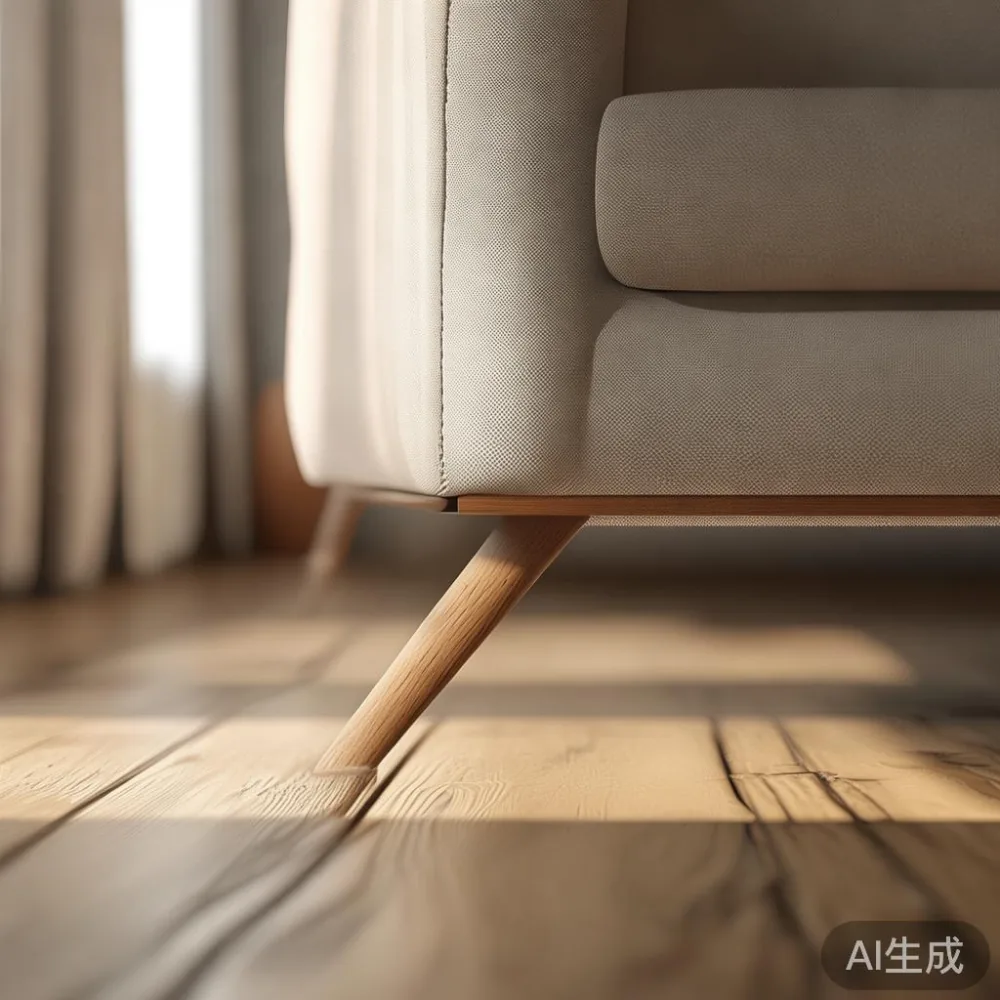
Mid-sized Foshan makers such as MIDHILL, established in 2008 and exporting to 15-plus countries, sell almost exclusively through specification rather than walk-in retail. Their sofa frames are kiln-dried solid wood, their slatted bed frames use the same timber, and their dining tables share the same joinery vocabulary as their wardrobes. That vertical consistency is what makes a blind purchase reasonable. The product category is identical from your bedside table to your three-seater.
What should I measure before ordering a sofa online in Singapore?
Measure five things, in centimetres, before you click pay: lift door width, lift interior depth and diagonal, corridor turning radius at your floor, the doorway threshold at your unit, and the final position you want the sofa to sit. Most Singapore passenger lifts in HDB blocks have a door opening of 80 cm to 90 cm and an interior roughly 1.1 m wide by 1.4 m deep, but the diagonal across the cabin is usually the binding constraint at 1.6 m to 1.8 m. A standard three-seater sofa frame unboxed is 210 cm to 230 cm long, 90 cm to 95 cm deep, and 85 cm tall, which often fits only if you tilt it.
Then measure the corridor. In a typical HDB block on the 7th to 12th floor, the common corridor is 1.2 m wide with right-angle turns at the lift lobby. A sofa with a chaise extension of 160 cm will not pivot around a 1.2 m corner without being tilted onto its arm. Tilt height becomes your real measurement: a sofa back of 85 cm becomes 95 cm to 100 cm when tilted on its side. If your lift interior ceiling height is 2.3 m, you have roughly 1.9 m of vertical clearance after accounting for the doorframe and the lift’s rubber bumper at the top. Always ask the seller for the box dimensions of the sofa in its most compact shipping configuration, and always ask for the assembled dimensions in three orientations: upright, on its back, and on its side.
Is the frame material actually solid wood, and does the certificate match?
This is the single most important question for any sofa above SGD 2,000. Particleboard and MDF frames flex under load, and the flex gets worse in Singapore’s humidity, which averages 80 percent relative humidity year-round. A solid wood sofa frame should use hardwood such as oak, ash, walnut, or beachwood (beech), kiln-dried to 8 to 12 percent moisture content. Ask the seller for three documents: the FSC or PEFC chain-of-custody certificate for the timber, the factory audit report (BSCI or Sedex is standard for Foshan exporters), and the formaldehyde emission test result conforming to E0 or CARB Phase 2. If they cannot provide all three within 24 hours, walk away.
At MIDHILL I have seen the kiln-drying schedule in person: 30 days at 58 degrees Celsius for the 38 mm rails used in their sofa frames, then 7 days of conditioning. That kind of disclosure is unusual. Most sellers will not even name the kiln temperature. For a buyer furnishing a full bedroom design suite, the same rule applies to the bed frame (look for mortise-and-tenon or dowelled corner blocks), the dining table (look for breadboard ends with elongated holes, not glued corners), the wardrobe (look for 18 mm to 25 mm solid side panels, not hollow board), and the nightstand (look for dovetailed or fully captured drawers). If the sofa checks out and the other pieces do not, you have a quality mismatch in your home within 12 months.
What fabric or leather specifications should I demand if I cannot touch them?
You should demand four numbers: rub count (Martindale), light fastness, pilling resistance, and cleanability code. For a family sofa in a Bedok or Sengkang HDB, I would not accept anything below 30,000 Martindale cycles for woven fabric and 50,000 for boucle or chenille. Light fastness should be 4 or higher on the ISO 105-B02 blue-wool scale, because most Singapore flats get strong afternoon western sun through the living room windows. Pilling resistance should be grade 4 to 5. Cleanability should be W (water-based cleaner safe) or W/S (water and solvent safe).
For top-grain or full-grain leather, ask for hide origin (European cowhide is typically 1.0 mm to 1.4 mm thick), tanning method (vegetable-tanned wears in, chrome-tanned wears out), and a sample swatch at least 10 cm by 10 cm mailed to you before production starts. Many Foshan factories will not swatch-match below a 2-piece order, but a reputable one will. If you are matching the sofa to a marble table or to the room’s post-modern light luxury direction, ask for the swatch held against your existing flooring under both daylight and 4000K LED at night. Colour shifts of one or two shades are common across these two light sources.
How do I care for a standing desk in humid weather?
Wipe the wooden frame and metal columns with a dry microfibre cloth every evening, run a dehumidifier set to 50 percent RH in the room, and apply a thin coat of hard wax oil to any exposed solid wood surfaces every six months to prevent the grain from raising. Singapore’s humidity is the single biggest threat to any solid wood furniture, including a sofa frame, and the same rule applies across your entire bedroom design set: bed frame, nightstand, dining table, and wardrobe all benefit from stable 45 to 55 percent RH.
What warranty terms actually protect me when I cannot test the sofa?
A meaningful sofa warranty names the structural frame, the spring or webbing system, the foam density, and the stitching separately. Look for 10 years on the frame, 5 years on the spring or webbing, 3 years on the foam (high-resilience foam at 32 kg per cubic metre or higher does not soften below 15 percent indentation over 3 years), and 1 year on stitching and zippers. MIDHILL, for one, publishes a 10-year structural warranty alongside a lifetime refinishing service, which means the frame is repairable rather than disposable. Lifetime refinishing is rare in this price band; most competitors offer 2 to 3 years and nothing after.
Check the return policy with the same intensity. A 14-day return window on stocked items is normal for Singapore e-commerce, but custom-upholstered sofas are typically final sale. If you are ordering custom, build in a 7 percent contingency for one alteration cycle, because first-attempt fabric drape on a tight-back cushion is almost never perfect. Confirm whether the seller absorbs return freight above SGD 350 (free shipping threshold) or bills it back to you at roughly SGD 80 to SGD 150 per cubic metre within Singapore.
How does GST, delivery, and installation affect my real cost?
Singapore charges 9 percent GST on all imported furniture as of 2024. On a SGD 4,200 sofa, that is SGD 378. Delivery from a regional warehouse to your door typically costs SGD 120 to SGD 220 for a single three-seater, with an additional SGD 60 to SGD 100 per floor if there is no direct lift access. Installation (placement, leg attachment, debris removal) is usually SGD 80 to SGD 150. So your SGD 4,200 sofa becomes SGD 4,778 to SGD 4,848 all-in. Always ask whether the published price is GST-inclusive and whether delivery is by the seller’s own crew or subcontracted, because subcontracted crews are the most common source of property-damage claims.
If your corridor cannot accommodate the sofa, the crew will charge a re-delivery fee of SGD 150 to SGD 250 for a second attempt, plus any corridor repair costs if the skirting is dented. A 2023 survey by the Singapore Furniture Association suggested that 1 in 7 large-item deliveries in HDB blocks involved some form of property contact, most often at the lift lobby turn. Insurance from the seller’s freight forwarder typically covers SGD 5,000 per incident, but you must photograph the corridor before the crew arrives to claim.
What questions should I ask the seller in writing before paying?
Ask nine questions in writing, and ask for written answers: (1) What is the unboxed weight in kilograms? (2) What is the box dimension in the most compact configuration? (3) What is the kiln-dried moisture content of the frame timber? (4) Can you send a fabric or leather swatch before production? (5) What is the foam density in kg per cubic metre? (6) Are the legs removable and what tool is required? (7) What is the corner-block construction on the frame? (8) Does your warranty cover humidity-related warping in Singapore? (9) Who handles property damage during delivery, and what is the insured amount?
Any seller worth your SGD 3,000 to SGD 6,500 will reply to all nine within one working day. If they cannot, treat that as the answer. Priya, my Punggol colleague, learned this after her own delivery. She has now ordered a two-seater with a separate ottoman from a different Foshan workshop, both pieces under 1.5 m long so they fit her lift cabin without tilting. Total spend SGD 2,180 including GST and delivery. The aesthetic is the French provincial direction she originally wanted, just rendered as small French provincial furniture proportions rather than one oversized three-seater. The room reads lighter, the corridor access is drama-free, and she actually sat on the showroom sample at the supplier’s office in Tai Seng before placing the order.
What does a healthy, low-risk blind sofa purchase actually look like?
It looks like this: solid wood frame with kiln-dried timber, 10-year structural warranty, lifetime refinishing option, FSC or PEFC certificate, 30,000-plus Martindale fabric or 1.0 mm-plus full-grain leather, free shipping above SGD 350, 14-day return on stocked configurations, and a written delivery plan that includes floor plan diagrams of your lift and corridor. It looks like a seller who has shipped to Tampines, Bedok, and Punggol HDBs before and can name a recent delivery date. It looks like a deposit of no more than 50 percent, with the balance due on delivery and after a 15-minute sit test in your own living room, with the option to refuse if the foam softness, fabric hand, or colour does not match the swatch you approved.
For a complete bedroom design refresh, apply the same nine questions to every piece in the room. A solid wood sofa should share its joinery logic with your bed frame, dining table, wardrobe, and nightstand. A marble table in the entryway should be paired with leather that complements its veining rather than competing with it. And the entire set should sit in a room where humidity is held to 50 percent RH, where curtains filter the western afternoon sun, and where a dehumidifier runs six hours nightly. That is what buying a sofa you cannot sit on looks like when the rest of the variables are controlled. The sofa becomes a known quantity, not a leap of faith.